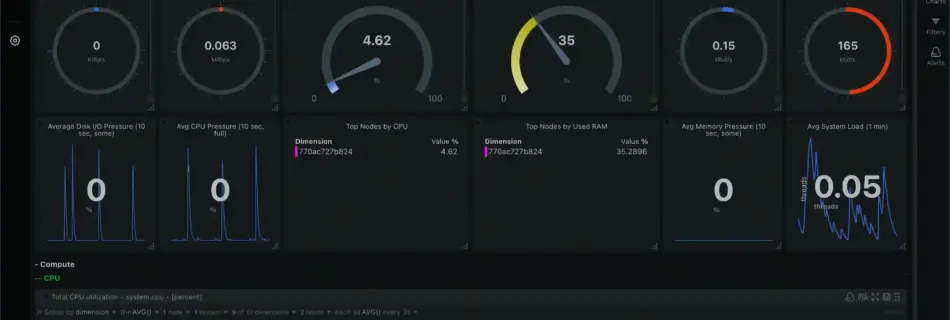
Setting up Netdata in Linux
Today we’re getting Netdata running in Docker and shaping the setup so it’s painless to back up.
Today we’re getting Netdata running in Docker and shaping the setup so it’s painless to back up.

If you’re running LibreNMS on a server somewhere and you’ve got a Raspberry Pi sitting on the same network, it’s worth pulling that Pi into your monitoring. It draws almost no power, it’s always on, and once it’s reporting data you’ll have graphs for CPU, memory, disk, network traffic, and temperature with very little effort. …
Read more “How to Install and Configure SNMP on a Raspberry Pi for LibreNMS Monitoring”
Problem By default, the Raspberry Pi Zero generates a random MAC address for WiFi connections to limit device tracking. While this is a good privacy feature for mobile devices, it makes it difficult to track and manage the device on your home network. Solution Disable MAC randomization by creating a NetworkManager configuration file. Steps 1. …
Read more “Disable WiFi MAC Randomization on Raspberry Pi Zero”
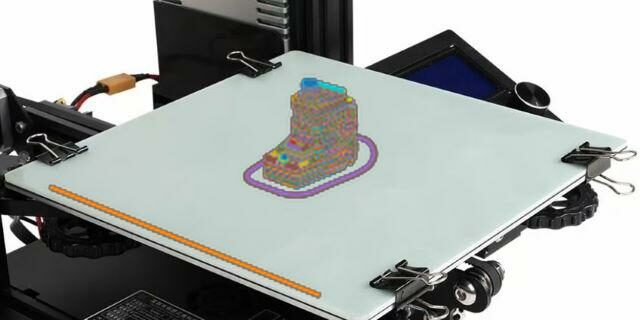
OctoPrint has a sweet plugin called octoprint-hologram which overlays a ‘hologram’ of the 3D print while your printing. If you attempt to install this from the plugin install in OctoPrint, this may fail and the issue is a dependency issue that Numpy requires you’ll need to manually add. I found the below solution here: https://github.com/MarkSlat/OctoPrint-Hologram/issues/1#issuecomment-2119084078 …

I found a neat way for stress testing my Linux machines using the CLI. Article at the end shows you how to install things but you basically install the two libraries that you need: Once you’ve done that, you run nproc to see how many cores you have (VERY IMPORTANT) This will simply output a …

This article was heavily inspired using ChatGPT and Bing although 99% of the ideas were more or less derived from ChatGPT. Introduction: Have you ever faced frustration when trying to run a Windows program on your Mac, only to hit a dead end? Or perhaps you’ve pondered over the obstacles standing in the way of …
Pi-hole is a Linux network-level advertisement and Internet tracker blocking application which acts as a DNS sinkhole and optionally a DHCP server, intended for use on a private network. https://en.wikipedia.org/wiki/Pi-hole This means that if set up correctly, all the devices on your network can benefit from the fact that some of the URLs your devices …
Read more “Setting up a Pi-Hole (DNS) Server on a Raspberry Pi Zero 2W (Stand Alone App)”
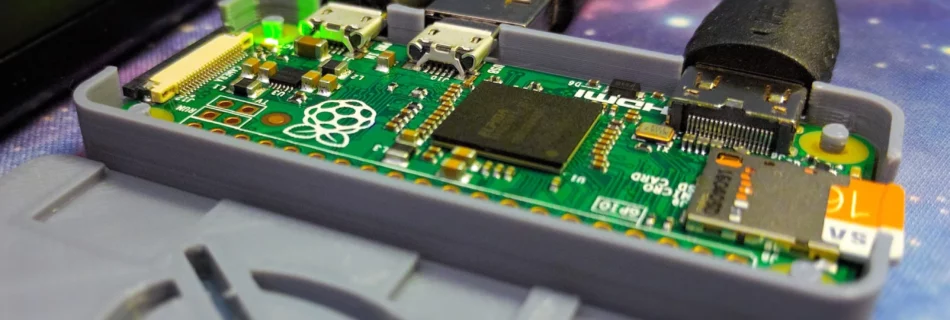
The purpose of this article is to get you started with the initial setup of RetroPie on the Raspberry Pi Zero. What’s awesome about this project is that anybody can jump right in and do it since there’s literally no previous coding knowledge necessary. The setup was a lot easier on the Raspberry Pi 3 …

The purpose of this article is to help you quickly install and configure the motion package on a Raspberry Pi (3 or 4). This should also theoretically work for several Linux flavors such as Ubuntu, Mint, Elementary, etc. Per their website, “Motion is a highly configurable program that monitors video signals from many types of …
Read more “Installing motion on a Raspberry Pi and managing the generated files”

Booting your Raspberry Pi from the SD Card can be slow and SD Card’s aren’t the most long lasting forms of media for physical data retention. Neither are NVME SSD’s but their write speeds are really good. To set up your Raspberry Pi to boot from USB, the details can be summarized as: Prerequisites Assuming …
Read more “Booting a Raspberry Pi from USB 3.0 Port Plugged in Device (e.g. SSD, HDD, FlashDrive)”